A Living Ark of Rainforest Diversity
When we stepped onto Lot 2 Old Forest Creek Road in the Daintree Rainforest, what we found was breathtaking.
Before committing to the purchase of land in the Daintree Lowland Rainforest, we conduct a thorough survey to confirm its natural values.
Ecologist and botanist Kristopher Kupsch carried out an exhaustive survey of Lot 2, and here’s a summary of his findings.
Across the 12 hectare property comprising pockets of remnant rainforest, open forest and wetlands, his survey recorded an astonishing 233 native plant species. Hidden among them were nine species officially listed as threatened, along with plants so rare they exist in only a handful of places on Earth.
This is no ordinary block of land — Lot 2 is a living ark of rainforest diversity. Donate now to help pay the deposit for this purchase.
A Rainforest of Global Significance
Lot 2 sits within one of the most important conservation landscapes on the planet. Its conservation significance notably contributes to extending and connecting both mapped ‘lowland rainforest climate refugia’ and large patches of mapped ‘lowland rainforest on alluvium’, with the ‘Wet Tropics World Heritage Area’ that is adjacent to the block. This connectivity function is crucial for biodiversity and climate resilience, mitigating the fragmentation effects that undermine these life-supporting ecological values where endangered ecosystems intertwine:
Notophyll and Mesophyll Vine Forest (RE 7.11.2a) – Dense, lush rainforest that shelters the Southern Cassowary. This ecosystem is officially recognised as “Of Concern” and vital to the survival of many rare species. Alexander Palms (Archontophoenix alexandrae) and Fan Palms (Licuala ramsayi) are characteristic of this ecosystem. Queensland government mapping indicates that just 100 hectares of this ecosystem exists.
Open Sclerophyll Woodland (RE 7.11.40a) – Rare and retreating. Broad-leaved Paperbark (Melaleuca quinquenervia) is a feature of this ecosystem.
Melaleuca Open Forest, Woodland and Shrubland (RE 7.3.5a) - This palustrine wetland regional ecosystem is mapped as occurring along the southern edge of the property and includes lowlands of the very wet and wet rainfall zone, on poorly drained peaty humic gley soils where the water table is near or above the ground for most of the year. This ecosystem recognised as “Endangered”.
Lot 2’s mix of rainforest and sclerophyll woodland makes it a biological crossroads — and a hotspot for discovery.
Donate now to help pay the deposit for this purchase.
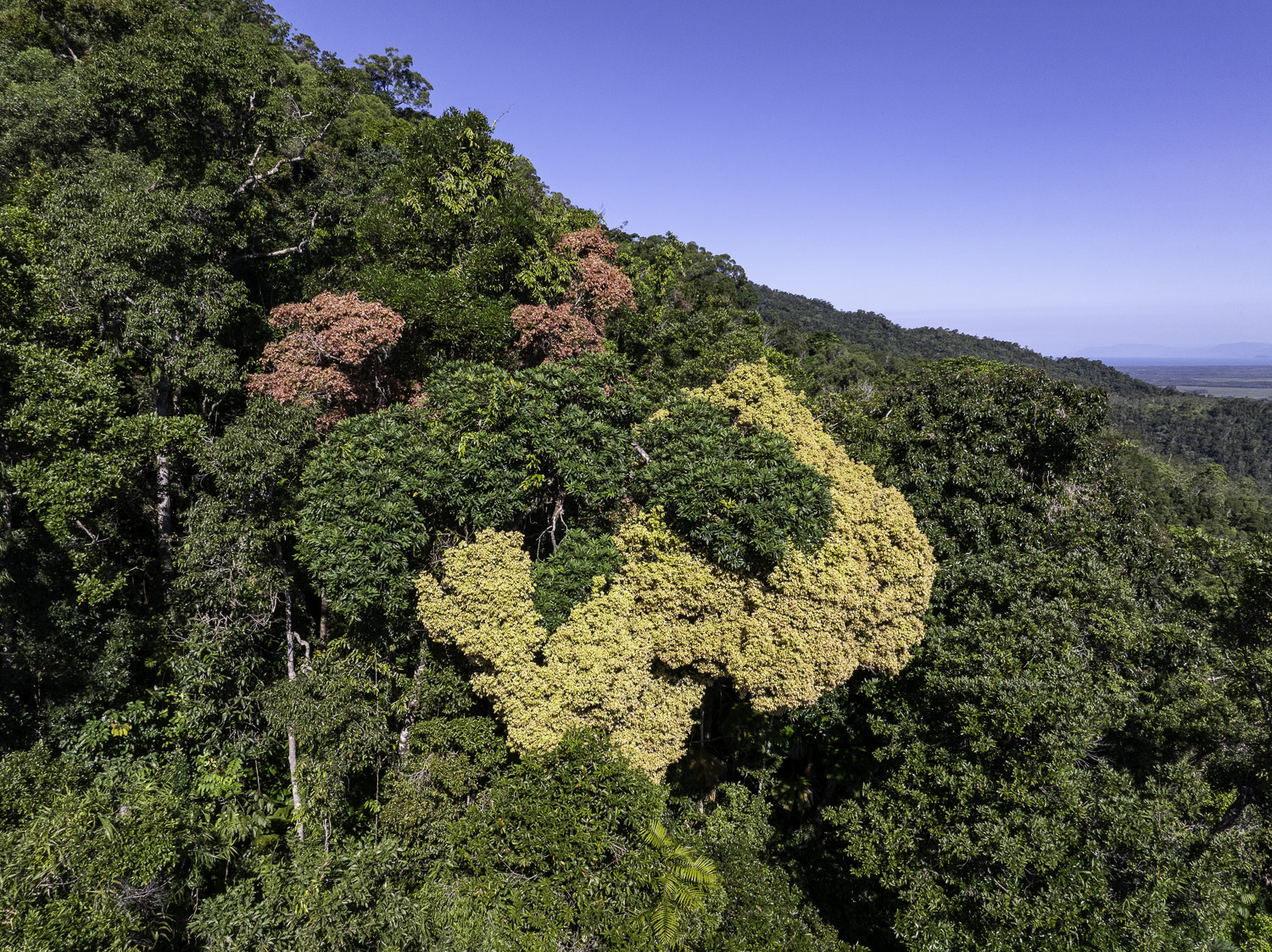
Canopy trees in the rainforest at Forest Creek.
Nine Threatened Plants Found
During his survey, Kristopher identified nine species listed under the Queensland Nature Conservation Act 1992 or the National Environment Protection and Biodiversity Conservation Act 1999:
China Camp Laurel (Beilschmiedia castrisinensis) - Near Threatened
This tree is listed as Near threatened under the Nature Conservation Act 1992. Its large fruit is dispersed by the Southern Cassowary. The species was observed as several seedlings and small sized saplings. The species is restricted to the area between the Bloomfield and Daintree River in lowland rainforest below 660m.
Gray's Walnut (Endiandra grayi) - Vulnerable
This tree is listed as Vulnerable under the Nature Conservation Act 1992. Its large fruit is dispersed by the Southern Cassowary. The species is restricted to the area between Cape Tribulation and the Daintree River at altitudes up to 40m. This tree was identified as several seedlings across the rainforest creek regions.
Noah's Walnut (Endiandra microneura) - Near Threatened
This tree is listed as Near threatened under the Nature Conservation Act 1992. Its large yellow fruit is dispersed by the Southern Cassowary. The species is restricted to the Daintree River and Cape Tribulation areas below 250m. It is often locally abundant where it is found however on Lot 2 was identified as only a couple small trees.
Giant Climbing Pandanus (Freycinetia marginata) - Endangered
This climbing monocot is listed as Endangered under the Nature Conservation Act 1992. It is quite prolific on Lot 2 being found in several places along the creek. It produces spectacular red floral displays.
Climbing Pandanus (Freycinetia percostata) - Vulnerable
This climbing monocot is listed as Vulnerable under the Nature Conservation Act 1992. It was found in one area as a very large thicket bordering the creek edge.
Ant Plant (Myrmecodia beccarii) - Vulnerable (EPBC-listed)
The epiphytic Ant Plant is present on Melaleuca quinquenervia and Lophostemon suaveolens. This unusual species is listed as Vulnerable under the Nature Conservation Act 1992 and the Environment Protection and Biodiversity Conservation Act 1999. It is restricted to coastal habitats between Cooktown and Ingham. The species is present within Regional Ecosystem 7.11.40a in the southwest portions of the lot.
Daintree Gardenia (Randia audasii) - Near Threatened
This small understorey tree is listed as Near threatened under the Nature Conservation Act 1992. It is restricted in patchy distribution from Atherton - Cooktown. It was identified within rainforest bordering the creek. Some specimens encountered on the lot were of significant size for the species.
Iron Malletwood (Rhodamnia sessiliflora) - Endangered
This small understorey shrub is listed as Endangered under the Nature Conservation Act 1992. It is present in a handful of rainforest sites bordering the creek. The exotic fungus Myrtle Rust threatens the species survival. Rust was not observed during field inspection.
Daintree Myrtle (Rhodomyrtus effusa) - Endangered
Each plant represents resilience, surviving over a century of clearing and logging. By protecting Lot 2, we ensure these species have a safe sanctuary for generations to come.
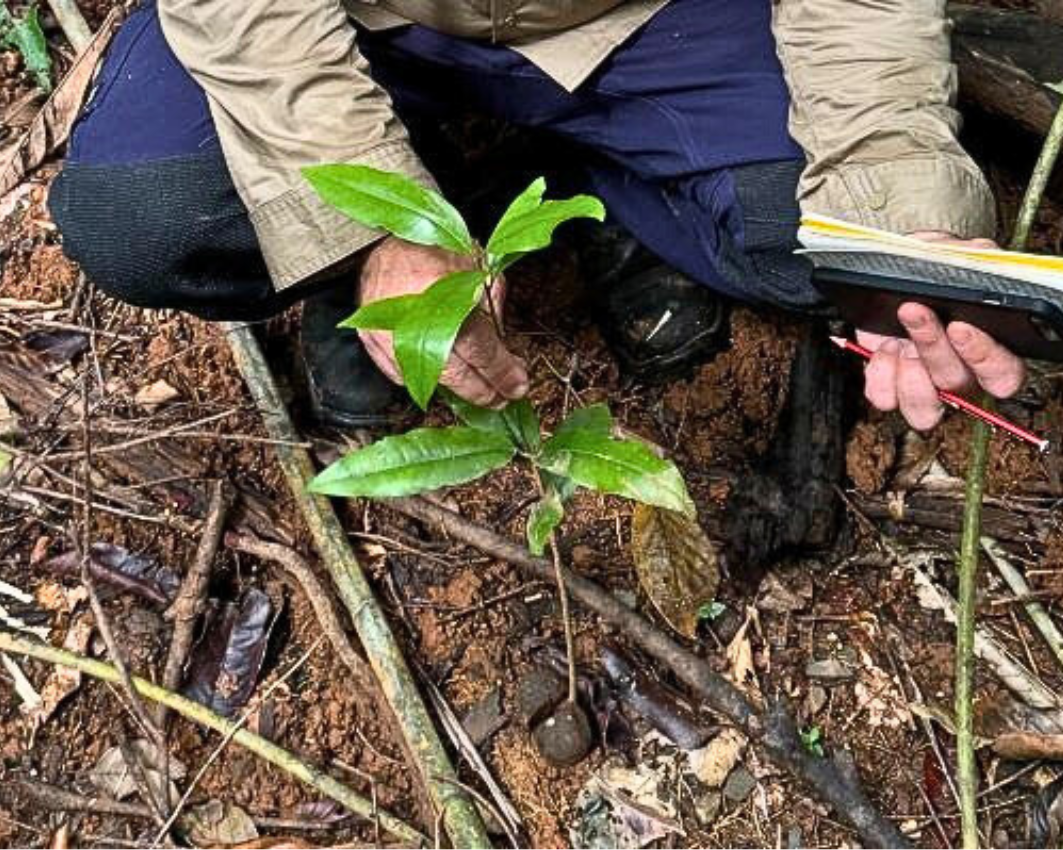
China Camp Laurel (Beilschmiedia castrisinensis).
Signs of a Thriving Ecosystem
Beyond threatened species, Lot 2 revealed more remarkable flora:
-
Daintree Foambark (Jagera madida) – Small tree restricted to Bloomfield–Julatten, a couple of specimens present along the eastern creek.
-
Hairy Tuckeroo (Sarcotoechia villosa) – Understorey tree marking its northern limit at Lot 2.
-
Cooper Creek Haplostichanthus (Polyalthia xanthocarpa) – Shrub restricted to Mossman Gorge–Cape Tribulation lowlands, occasional along the creek.
-
Giant King Ferns (Angiopteris evecta) – Living fossils from an ancient lineage, thriving along the creek edge.
-
Daintree Satinash (Syzygium monospermum) – Flowering specimens bordering the creek, fruit eaten by Southern Cassowaries.
-
Dinghoua globularis – Understorey sapling at the northern creek boundary.
-
Noah’s Corduroy Tamarind (Mischarytera megaphylla) – Rare endemic extending its range south into the Daintree River catchment, observed as a single seedling.
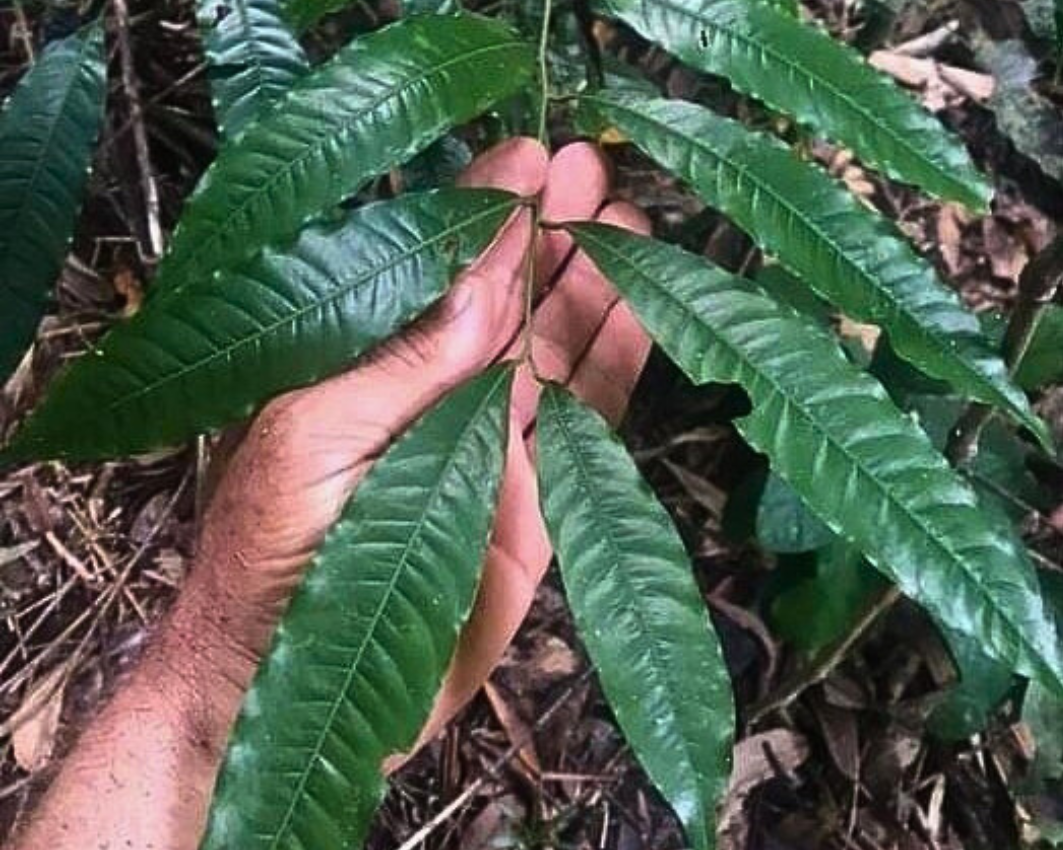
Noah’s Corduroy Tamarind (Mischarytera megaphylla).
Habitat Connectivity and Landscape Significance
Lot 2 provides crucial linkages across the landscape via vegetated waterways from the foothills to the floodplain. Situated within the Daintree River catchment draining into the Coral Sea and Great Barrier Reef, it connects with the Alexandra Range bordering Thornton Peak (1,374 m).
The terrain is mostly flat, with two creeks dissecting the property. Vegetation along alluvial soils supports species of high conservation importance. Many rainforest plants here are at their northern or southern distribution limits, and one species extends its known range across the Alexandra Range.
The property covers 12 hectares, with approximately 5 hectares of remnant vegetation. Seven hectares were cleared for grazing decades ago, now overgrown and targeted for an integrated regenerative agriculture restoration project starting in 2025.
Cassowary scats were also found on site — proof that these majestic “gardeners of the rainforest” are already using Lot 2 as essential habitat. Donate now to help pay the deposit for this purchase.
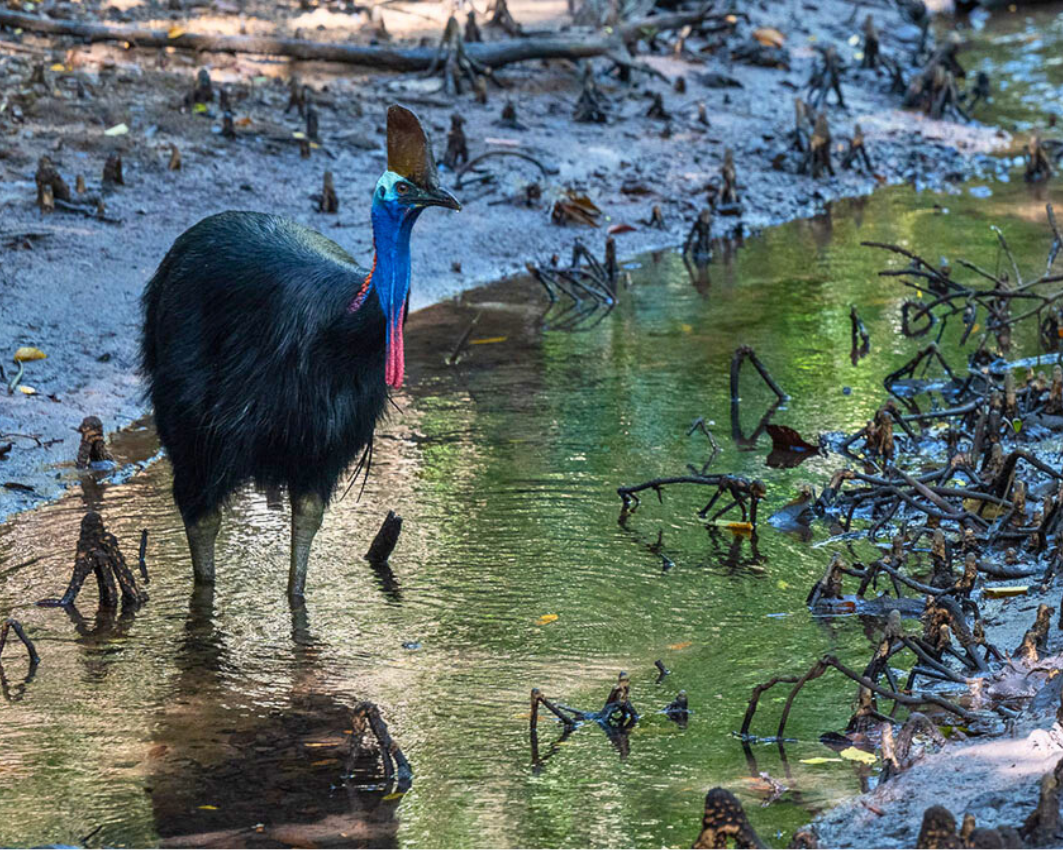
Southern Cassowary (Casuarius casuarius johnsonii).