How the Southern Cassowary Keeps the Daintree Alive
Walk along a creek in the Daintree and, if you're lucky, you'll see one. A flash of glossy black feathers. A vivid blue neck moving between the buttress roots. The endangered Southern Cassowary (Casuarius casuarius johnsonii), unhurried, going about its irripacable work.
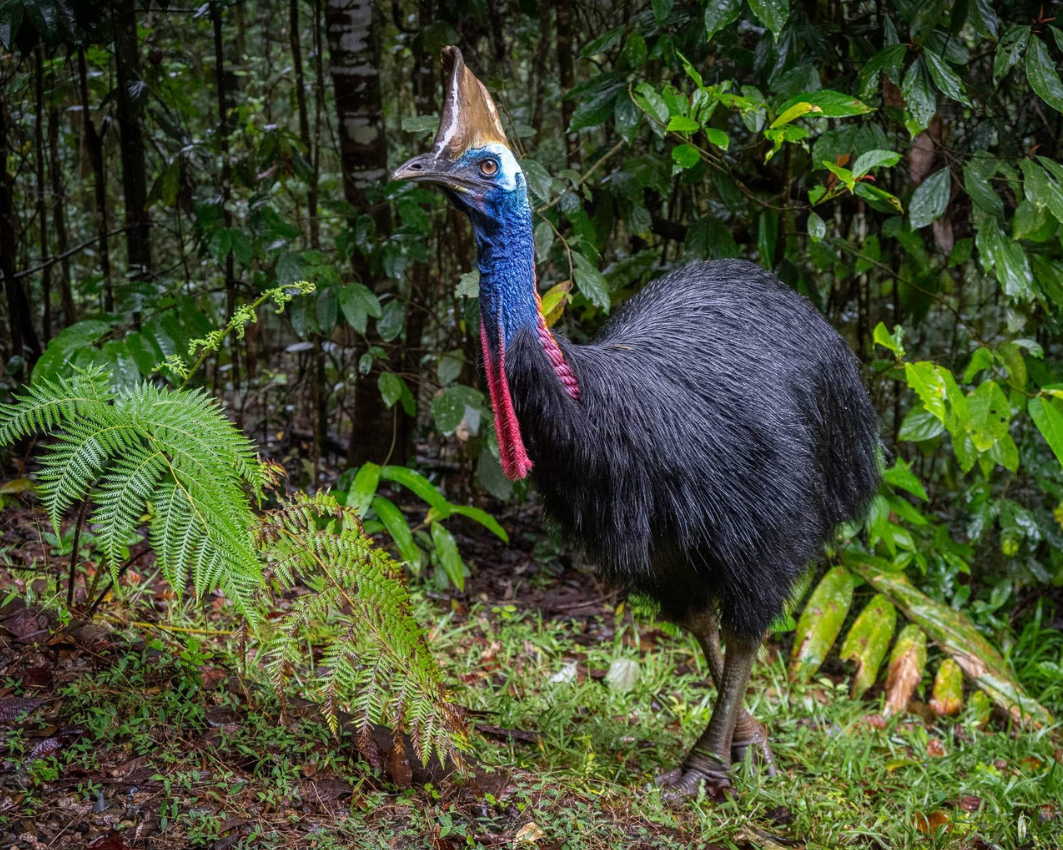
The Southern Cassowary (Casuarius casuarius johnsonii). Image: Steven Nowakowski
The only one for the job
More than 70 species of large-fruited rainforest trees depend on the Southern Cassowary to spread their seeds.
Trees like Noah's Walnut, with its heavy yellow fruit, and the native laurels that litter the forest floor with fleshy fruit, produce seeds too big for almost anything else to swallow. The Black Palm, known to the Eastern Yalanjiwarra as Duwar, and an important food and cultural resource, drops bright fruit that few animals besides the cassowary can eat and carry away.

The fruits of Black Palm (Normanbya normanbyi). Image: Steven Nowakowski
The cassowary can. It swallows the fruit whole, walks on, and later deposits the seed somewhere new, often well away from the parent tree, wrapped in its own ready-made fertiliser. For many of these species, a cassowary is the only way their seeds get a start in life.
It's why the cassowary has earned its nickname: the gardener of the rainforest. When cassowaries move through the rainforest, they help plant the next generation of rainforest trees.
A gardener that has to keep moving
Rainforest trees don't all fruit at once. Different species ripen at different times, in different pockets of forest. To find enough food across the year, a cassowary has to roam widely — through gullies, across creeks, between properties, following the fruit as it comes into season. Every one of those journeys is a seed dispersal event. Every one depends on the forest ahead still being forest.
This is why the Southern Cassowary requires large, connected areas of habitat, not just isolated pockets of it. Vehicle strikes are the single greatest cause of cassowary deaths in this region, a sobering reminder of what happens when a bird built to roam meets a landscape it can no longer move safely through.
What we've seen with our own eyes
At Lot 2, Thornton Peak Drive in Forest Creek, our team recorded cassowary activity along the small creek running through the property. Real evidence that this bird is still moving through this stretch of the Daintree, still doing its work. And he isn't alone!

The Southern Cassowary (Casuarius casuarius johnsonii) and chick using Lot 2.
That's the case we find on so many of the properties we protect. It's never just about the trees standing on a block today. It's about keeping the path open for the animal that plants tomorrow's forest.
Your part in the story
When you help purchase and protect a Daintree property, you're doing more than saving what's growing there right now. You're keeping a doorway open for a cassowary to pass through, feed, disperse seed, and keep gardening this ancient forest the way it has for millions of years. The rainforest is strongest when it's connected.