In the Daintree Lowland Rainforest, every protected property tells a story. Through restoration, tree planting and long-term protection, degraded areas can once again become a thriving and connected rainforest habitat.
One powerful example is Lot 93 Cape Tribulation Road, where more than 1,500 native trees were planted on what was once a road. Today, that former road is no longer a break in the forest. It is becoming a reconnected rainforest again, creating a safer and more continuous habitat for wildlife.
Why tree planting matters
The Daintree is the world’s oldest continuously surviving tropical rainforest, home to rare and threatened plants, ancient lineages and threatened wildlife, including the Southern Cassowary. However, parts of the lowland rainforest were subdivided in the 1980s, leaving many areas fragmented by roads, cleared land, and private blocks at risk of development.
Fragmentation is one of the biggest threats to rainforest ecosystems. When rainforest is broken into smaller sections, wildlife has to move through open or disturbed areas to find food, shelter and breeding habitat. For species like the Cassowary, a connected rainforest is essential for survival. These large, flightless birds need safe corridors to move across the landscape, and as they travel, they disperse the seeds of many rainforest plants.
Tree planting helps repair these broken links.
By planting native rainforest species, we can help restore canopy cover, rebuild habitat and reconnect isolated patches of forest. Over time, these plantings become part of the living rainforest system, providing food, shelter and movement pathways for wildlife.
Lot 93: from road to reconnected rainforest
Lot 93 Cape Tribulation Road is a clear example of what restoration can achieve. Where there was once a road cutting through the landscape, more than 1,500 trees have now been planted by our wonderful volunteers. This work has helped transform a disturbed strip of land into a regenerating rainforest corridor.
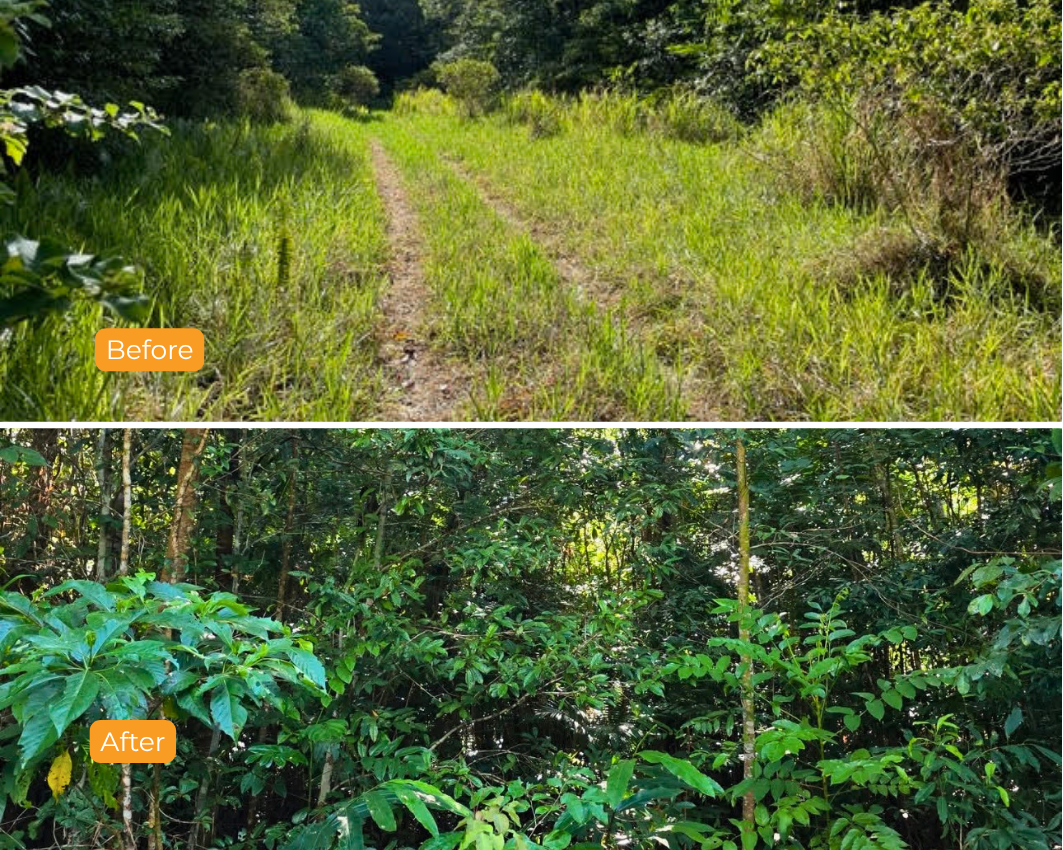
Once a road, now reconnected rainforest.
The change is more than visual. Reconnecting rainforest improves habitat quality, supports wildlife movement and helps restore the natural processes that keep the Daintree alive. As the trees grow, they create shade, stabilise the soil, improve moisture levels and provide structure for other plants to establish.
For wildlife, this matters. A connected forest gives animals a better chance to move safely, find food and shelter, and continue playing their role in the ecosystem. For the rainforest, it means stronger resilience and a better chance of long-term recovery.
Restoration is a long-term commitment
Tree planting is only one part of rainforest restoration. After trees go into the ground, they need care. Restoration work can include weed control, monitoring, replacing lost plants and supporting natural regeneration. The goal is not simply to plant trees, but to help the rainforest recover as a functioning ecosystem.
In some areas, direct seeding may also be used, where suitable native seeds are placed directly into the ground rather than grown first in a nursery. In other areas, assisted regeneration provides the best possible start.
Every site is different, but the aim is the same: to restore and protect damaged land and help reconnect the Daintree Lowland Rainforest.
Protecting and restoring the Daintree
Our work focuses on purchasing, protecting and restoring rainforest properties in the Daintree. Buying back vulnerable land prevents the risk of development, while restoration helps repair areas that have already been disturbed.
Lot 93 Cape Tribulation Road shows what is possible when protection and restoration come together. A road has been replaced with young rainforest. With time, those trees will become habitat, food sources and shelter for wildlife. Rainforest restoration takes patience, but every tree planted is part of a bigger story: reconnecting and protecting the Daintree, one freehold property at a time.
Your support helps protect and restore vital rainforest habitat. Together, we can turn damaged land back into rainforest and reconnect habitat for wildlife for generations to come.