Habitat: Northeast Queensland’s tropical rainforest, in dense vegetation surrounding lakes and streams
Life span: Around 4-5 years
Distribution: From west of Ingham, Queensland, at Mt. Lee to Mt. Amos south of Cooktown, and low altitude rainforests, such as Cape Tribulation and Mission Beach
Conservation status: Least Concern on the IUCN Red List
About
The musky rat-kangaroo (Hypsiprymnodon moschatus) is a small macropod found only in the tropical rainforests of northeastern Queensland, Australia. Their range spans approximately 320 km of coastline, where they live among dense vegetation near streams and lakes. These shy, reclusive animals usually sleep in nests hidden between the buttress roots of large rainforest trees.
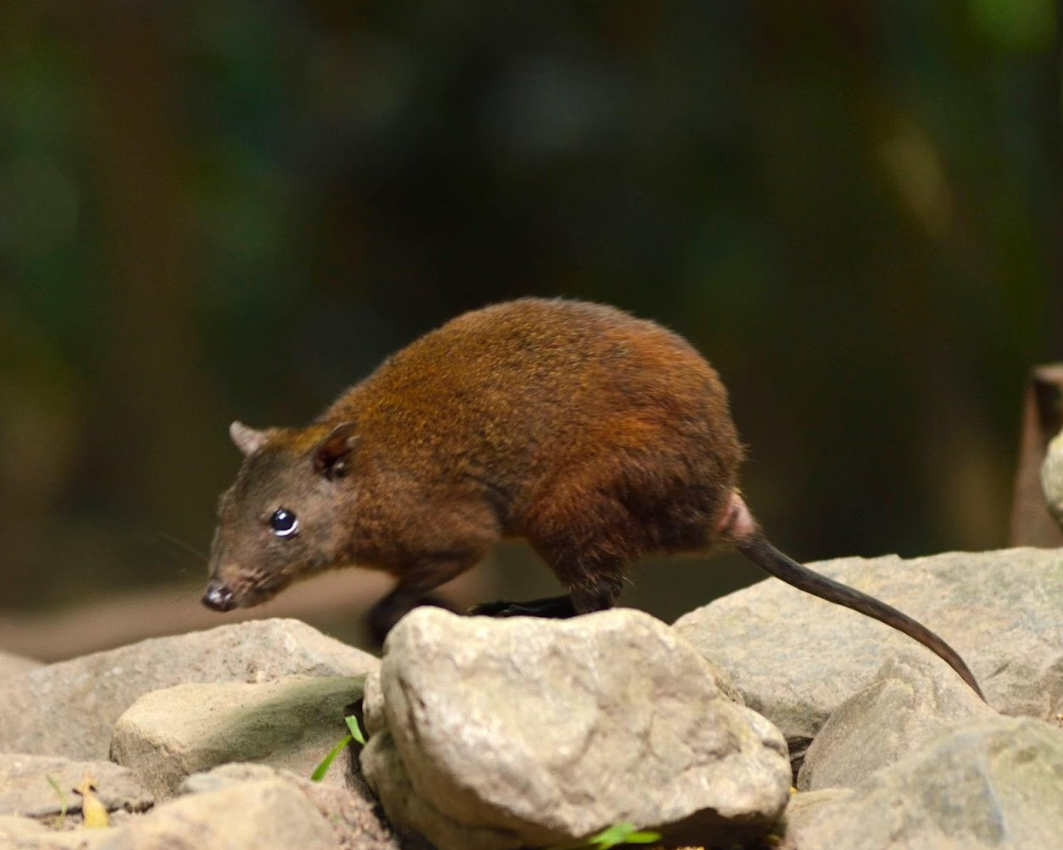
The musky rat-kangaroo. Image: Steven Nowakowski
Fun fact: They have a distinctive musky scent, which is where their name comes from!
What they look like
Musky rat-kangaroos are the smallest and most primitive members of the macropod family. Their bodies measure 208–341 mm, with a short 65–123 mm tail that is hairless and looks more like an opossum’s than a kangaroo’s
A unique way of living
Unlike most kangaroos, they run on all fours rather than hop. They are also one of the very few truly diurnal macropods, meaning they are mostly active during the day. Musky rat-kangaroos are solitary but may sometimes feed in small groups, and they use their tails to gather dried leaves, grass, and lichens to build their nests.
Diet and behaviour
Their diet is mostly insectivorous; they eat insects, worms, roots, and berries. They sit upright while feeding and search for food by digging through leaf litter and soil.
Breeding
Breeding occurs during the rainy season. The female usually gives birth to two young, which leave the pouch at around 21 weeks but continue using nests for a few more weeks. Both males and females reach sexual maturity at about one year of age.
Why they’re special
This species is considered the most primitive living macropod; they are an evolutionary link between ancient arboreal marsupials and the kangaroos we know today. They have a clawless first digit on the hind foot and the characteristic scaly tail that sets them apart from their relatives.
Conservation
The musky rat-kangaroo is currently listed as Least Concern on the IUCN Red List, with much of their habitat protected within the Wet Tropics World Heritage Area.
A connected rainforest is essential for healthy ecosystems. You can help protect vital habitat in the Daintree here.